

Comeback Queens
Some players like Barbora Krejcikova have mastered how to return from injuries, while others like Zheng Qinwen are discovering it. Here they share the experience.

Welcome back! In today’s edition, I had exclusive chats with two players coming back from injuries at very different parts of their careers. Zheng Qinwen and Barbora Krejcikova have been sidelined or hampered by right elbow and left knee injuries, respectively, and hope the Middle East swing will get them back on track. One is unfortunately used to having to deal with serious injuries, while the other is going through the frustration of a first big one. Both are adamant that they can climb their way back to the top. I’ve also inserted some food for thought on a totally different topic, from Valentin Vacherot.
Also, feel free to spread the word, like this post, subscribe, become a paid subscriber, or leave a comment, to help TSS's discoverability. You can prefer to buy me a cuppa!

QueenWen Is Back: “It’s time to go and try to beat them.”
Zheng Qinwen, 23, has been struggling with a right elbow injury for most of 2025, undergoing surgery in July before attempting to return to competition in Beijing in September. Yet, the Olympic champion and WTA Finals finalist, who had reached the quarterfinals at Roland-Garros, relapsed and had to shut down her year. Still unable to compete at the start of 2026, the Chinese star, who was World No.4 last June, is finally able to enter a WTA draw, in the 1000 of Doha. I caught up with her on Saturday: her frustration with the situation, the tears, the lessons, watching loads of tennis, and her impatience to climb back.
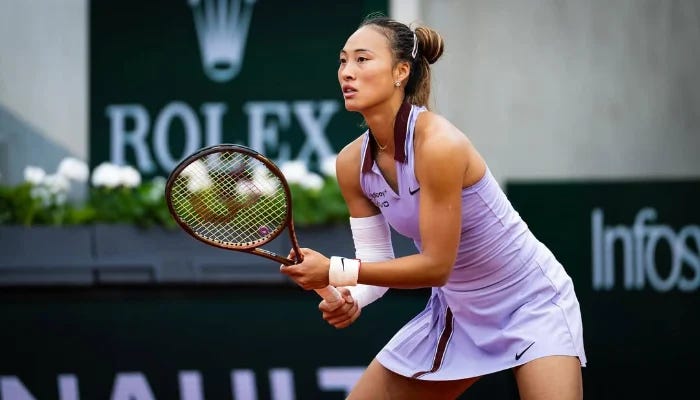
Carole Bouchard, The Tennis Sweet Spot: Nice to see you back! I’m sure you’re happy to finally compete after all this time. How do you feel ahead of your first match of the season, in Doha?
Zheng Qinwen: Yes, I’m super excited to be back again competing with all of these players. Because it’s been a long, long time, and I could only watch them on TV and focus on my own rehab stuff, trying to heal my injuries. That was a much longer process than I thought, but at the end, here we are, I’m back again. And let’s see how my performance goes this week.
Carole Bouchard, The Tennis Sweet Spot: Since when have you been able to practice normally?
Zheng Qinwen: Well, the problem is that two weeks before the Australian Open, I was still unable to hit a tennis ball. So I had to start very slowly, and one week before the Australian Open, I could already hit from the baseline, but couldn’t serve yet. So it was a very sad decision for me not go to the Australian Open, and also I had a lot of regrets, honestly, about playing last year as I realized after a few months that my elbow wasn’t ready yet to compete. But I got the information from the doctor. The doctor told me I could go. So we listened to his opinion. Yet, the reality showed us we couldn’t, and in the end, that’s why the process takes longer. But we all learn from mistakes. So next time I will be careful about those things. Now, let’s see how it goes.
Carole Bouchard, The Tennis Sweet Spot: Mentally, how did you cope with all of this?
Zheng Qinwen: It was different this time. Because after my surgery, I was aware I was going to have to miss the US Open, so I just watched them all like I’m an outsider, a tennis fan. But the decision not to go to the Australian Open actually hurt, because I know it was because we didn't make good enough decisions. But at least we tried really hard. Still, it was tough for me to accept, and I was crying in the bathroom. Like, why are we doing that? Why is my elbow not recovering? Why? A lot of questions. But in the end, I have to accept it because it was the right thing to do: if I’m still not able to serve, how and why am I going all the way to Australia? I cannot go there and just be like, “Let’s see how I’m going to do.”But at the same time, you know, I had the time to watch all these players competing. When I’m in the competition, I’m not used to watching them a lot. But this time I’ve been able to watch both men’s and women’s tennis. Very interesting! Actually, I spent a lot on the tennis iQiyi (a Chinese subscription video on-demand streaming service) for being able to watch the Australian Open! (She laughs) Before, when I was in the tournaments, it was always free!
Carole Bouchard, The Tennis Sweet Spot: Are you playing pain-free now? Or is it still something you have to manage?
Zheng Qinwen: Well, when I was training in Abu Dhabi (before coming to Doha), I wasn’t 100% yet. But right now, I can say I’m quite there. Let’s just say I’m 95%. I’m able to hit free, serving quite free as well, so I’m looking forward to competing.
Carole Bouchard, The Tennis Sweet Spot: Often, tennis players, when they come back from injuries, they’re like, OK, it was hard, but at the same time, it gave me time to pause, reflect, or learn some things. Are you able to take something positive from this?
Zheng Qinwen: Yes. I would say this period of time makes me see how to learn to make better decisions because here I took the wrong decision based on wrong information or not enough information. So next time I make a decision, I’ll gather more information from different people, and in the end, I’ll have a much better chance of making the right one. This is what I learned from my injuries. And also, to watch men and women playing - sometimes I put two screens to watch them - because that was interesting. I enjoyed watching some of the players and how they perform on the court. I enjoy tennis, not as a competitor, but as a fan.
This period of time makes me see how to learn to make better decisions …
Carole Bouchard, The Tennis Sweet Spot: Any players you’ve been watching more than others?
Zheng Qinwen: Of course, I’ve been following Alcaraz, Sinner, Djokovic, how they play, and also Sabalenka, and also Rybakina, all these top players. They had a great performance at the Australian Open. And now it’s time to catch up. I cannot always be there as a fan behind the screen, right? It’s time to go and try to beat them.
Carole Bouchard, The Tennis Sweet Spot: Did you have to change your serving motion at all due to that elbow injury?
Zheng Qinwen: Yes, I have to change a bit, but it’s not a big change. Just a focus on the smaller details, like trying to be able to toss the ball always in the same place, and try to have more accuracy, and of course, to be more successful in the first serve.
Carole Bouchard, The Tennis Sweet Spot: You have, logically, big ambitions, but are you coming back with specific targets, or is it also learning not to already expect too much of yourself because it’s just a comeback?
Zheng Qinwen: Well, the target is always there, but I would say, compared to before, I play a different tennis because I’ve been learning a lot all these six months without competing. And what I ever did in the past is already passed, so right now I have to start new because right now my ranking drops, everything starts to drop. So if I want to take the spot back, I’ve got to work harder, compete harder, and then try to be as humble as I can. Let’s be there and let’s fight.
I’ve got to work harder, compete harder, and then try to be as humble as I can.
That was frustrating because in Beijing at the China Open, even though I couldn’t serve 100%, I was still able to play some good tennis from the baseline and at the net. But that’s how it goes. I have to accept and try to look forward to doing the best I can with the conditions I have. But I’m just really, really happy my elbow can come back to a good stage right now because I’ve been praying for someone to finally help me! And finally, my praying seems to be working a bit. Let’s see if it’s going to continue to work well.
“I’m giving other players some hope,” Valentin Vacherot
Inspiration doesn’t always come from the top of the crop. And we tend to forget it. Sure, kids will watch Alcaraz, Sinner, Sabalenka, or Gauff and be inspired to pick up a racquet. But sometimes, it’s a Cinderella story that will do the job, not the mastered perfection.
When I was in Hong Kong, I had a post-match chat with Lorenzo Sonego, an already experienced player, and as we were talking of how he’s still trying to improve and reinvent himself, he said that part of that new fire has of course been Jannik Sinner showing the way but also what Valentin Vacherot did in Shanghai at the end of las year. I found it quite interesting that a player like this had kind of lost all hope of seeing a lower-ranked player pull off all the upsets and win a Masters 1000, but seeing Vacherot do it inspired him to believe again. That’s actually what decades of Big 4 domination, now followed by the duopoly rule, did to the rest of the field.
So in Melbourne, I asked Vacherot about it: does he still feel the impact his win had on some of his peers, and does it feel weird? Here is his answer: “It’s one of the things that makes me most proud of that run in Shanghai. Martin Damm (whom he had beaten in the first round in Melbourne): When we shook hands, he told me directly, “Your rise is so inspiring, man, keep going”. These are things that make me really happy because I’m giving other players, some hope, which means they might think that it’s going to happen to them too, and I’m very proud of that.”
I thought it was both cute and interesting, so of course I’m sharing. We often say some matches are won in the lockers, but actually, entire tournaments are won there. Sure, what happened to Vacherot might never happen again, but maybe what can happen is some players straightening that spine a bit.
“I definitely enjoy, but the health part is complicated,” Barbora Krejcikova
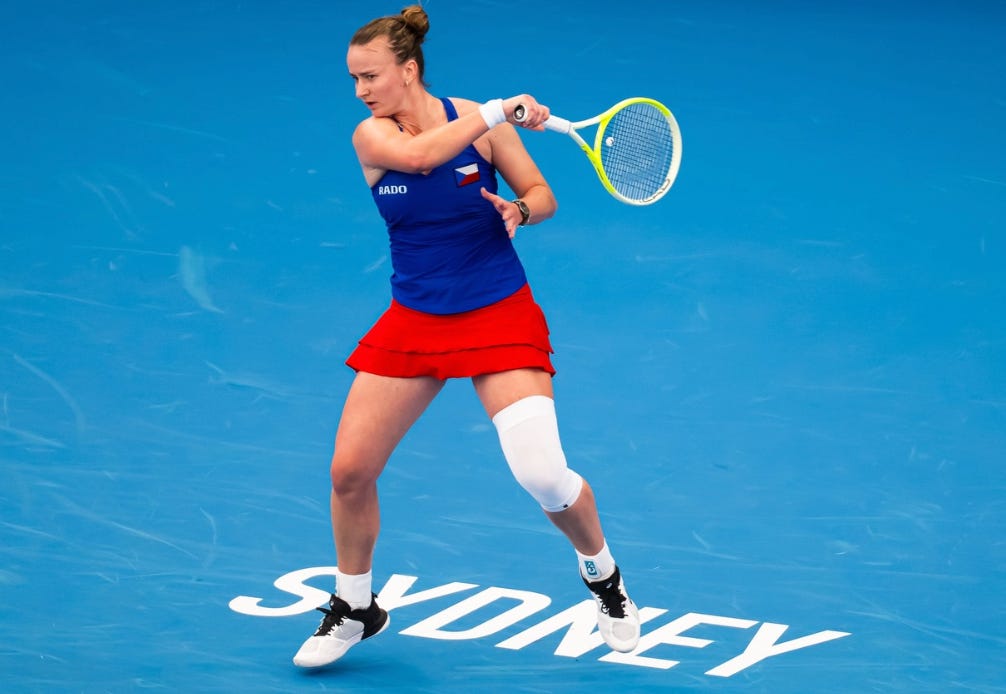
One can wonder how many Grand Slam singles titles Barbora Krejcikova might have won if her body had chosen to cooperate. The Czech, Roland-Garros and Wimbledon champion, is trying to get over a serious knee injury after having already had to go through a right elbow and then a severe back injury in recent years. I caught up with her in Doha, where she withdrew from singles at the last minute but won in doubles with Katerina Siniakova.
I met with her on Sunday evening after a doubles match, quickly letting her know what I wanted to chat about, and immediately she laughed and just said the only answer was that she was old. I’m like, Barbora, you’re not old. She laughs and literally yells: “I AM OOOOLD”. So that’s how our interview started, in complete hilarity after me telling her if she’s old, then I’m ancient, and her insisting she’s the oldest of them all.
Carole Bouchard, The Tennis Sweet Spot: You withdrew from singles but just won in doubles, so I’m just curious about how that knee is going and if you can see the end of the tunnel with that injury…
Barbora Krejcikova: I am improving. Let’s say that I am improving. I am managing the position that I’m in. I was hoping that I could be ready for this one, but during the practices, I feel I am at like 50%, so I’m like halfway there, but not fully ready for singles. That’s why I decided to withdraw, but also at the same time I am ready to play doubles, so I’m really happy that I was able to get in touch with Katka (Katerina) and that we can play here together and hopefully get some matches to slowly build up again my way back to the singles field.
Carole Bouchard, The Tennis Sweet Spot: Do you take it as a good sign that you’re able to play doubles, or are you more worried about the fact that you still can’t play singles?
Barbora Krejcikova: No, it’s very good. I’m really happy that I can play doubles, and same I pretty much had to skip the Australian Open because of what happened during the previous tournament in Hobart, so that was very unfortunate, and I was really sad and disappointed about it, but that’s the way it is. As soon as I got better in Australia, I started to practice again and do more of the physical preparation, and then later on, I also started with tennis, let’s say more in Abu Dhabi, but the knee stopped being painful inside, so now it’s more muscular, and it needs some time to adapt. The muscles are definitely not happy that I’m working them out! (She laughs) They are very sore, and they don’t like it, but they gotta adjust and get ready because I want to play, and I’m very excited to play singles again and to be healthy, to be pain-free, and start having some good results in singles again.
Carole Bouchard, The Tennis Sweet Spot: Unfortunately, it’s not your first serious injury, especially in recent years. How do you cope with this one more time?
Barbora Krejcikova: Well… Everything happens for a reason… It’s not that I go crazy about it all. I mean that’s part of the part of the life, so I’m getting old! You cannot avoid that… It’s gonna come, and it’s going actually very fast, so it’s tough, and I think it’s not gonna get any easier anymore, but I still appreciate that I can be here and I can play, and even though I’m going through tough times and through injuries, that’s part of the game. It’s just the way it is, and I’m accepting that I’m trying to stay patient.
Every single day just wake up, get back at it, warm up, get on the court, do what I need to do even though it’s boring but just really trying to get back and trying to stay patient and hoping that I’m gonna wake up one day and I’ll be able to play and that it’s gonna stay like that for a longer period.
The most important thing is to feel healthy and to enjoy.
Carole Bouchard, The Tennis Sweet Spot: What still pushes you? I mean, you’ve won so much already, so where do you find the fire to get back at it one more time?
Barbora Krejcikova: I love tennis. I’m very passionate about it, and I love to compete. I love the challenges that tennis is still bringing me. I love to play against the younger players. I love playing against players who are evolving and improving. I’m trying to stay with them as well, get better as well, and try to compete with them. That’s what I love about tennis, but now for me, the most important thing is to feel healthy and to enjoy. I definitely enjoy, but the healthy part is complicated.
Carole Bouchard, The Tennis Sweet Spot: Do you have an idea of when you’re going to be able to play singles again?
Barbora Krejcikova: I go day by day. A couple of days ago, I only stepped on the court for 30 minutes, and now I can play some singles points for 60 to 90 minutes, which is nice. I’m trying to level this up, and I’m hoping to play singles next week in Dubai.
This week is more of a last-minute agreement, and also for me, with all the injuries, it’s just difficult to play in two competitions right now.
Carole Bouchard, The Tennis Sweet Spot: About doubles, is this just for this week with Katerina Siniakova, or is the band back together?
Barbora Krejcikova: (She laughs) Katka is set with Taylor, and they are doing great stuff, playing really well together, so I’m really happy for her, and I’m glad that she found a good partner and that she can enjoy tennis and play well. This week is more of a last-minute agreement, and also for me, with all the injuries, it’s just difficult to play in two competitions right now. But I’m really glad that I can play with her because I like playing with her, and even though we don’t play that much, I still know exactly what she does, so it’s very natural for me when we play together. But also at the same time I still want to play singles and I think if I want to have a good shot in singles with everything that I’m going through and with my elderly status I just need to play a little bit less matches and be a little bit better with the scheduling and the way how my body is responding to the load and to the system that is here right now.
I bet Zheng Qinwen learned a lot watching those other players, not to mention commentary pointing out their weaknesses. It will be interesting to see what she adds or changes about her own game.
Typo: Australian in "pretty much had to skip the Austrian Open"