
Czech Creativity Takes It All, While Gauff's Game Gets Unlocked
Czech tennis is a wonder, and Wimbledon shows it again. Both efficient and stylish? How? Also, Coco Gauff lost, but her game looks the best it's been in years, so watch out.

Welcome back!
It’s nothing new in tennis, but it’s yelling in our face right now at Wimbledon: Czech tennis has really done it. What? Breaking the tennis code. Linda Noskova and Karolina Muchova will keep the flag on the Centre Court one more time, and one has to not only wonder how, but also ask why the hell other countries don’t seem to get curious about it. And not only do they win a lot, but they also do it with flair. Both efficient and stylish? Haven’t they heard about that “can’t have it all” thing?
I know professional tennis is a winner-take-all situation, but sometimes a loss looks like the biggest win in a while. That’s how I feel for Coco Gauff: She lost that semifinal (yes, I know, despite THAT match point), but she unlocked that game in a way we were starting to wonder she’d be able to do again. For the first time in something like two years, I was like, “Oh, Welcome Back, Coco Gauff.”
Don’t forget to take advantage of my special Wimbledon offer and get 15% off a paid subscription to the Tennis Sweet Spot. Also, feel free to spread the word, like this post, subscribe, or leave a comment to help TSS’s discoverability. You can prefer to buy me a cuppa!
Czech Creativity Takes It All
Linda Noskova and Karolina Muchova gave Czech tennis a Wimbledon final, ensuring that the country will add one more line to the long list of its Wimbledon champions. How? Why? How can others do the same? Also, it’s not only how much they win, but also how creative these players happen to be, each in a very different way.
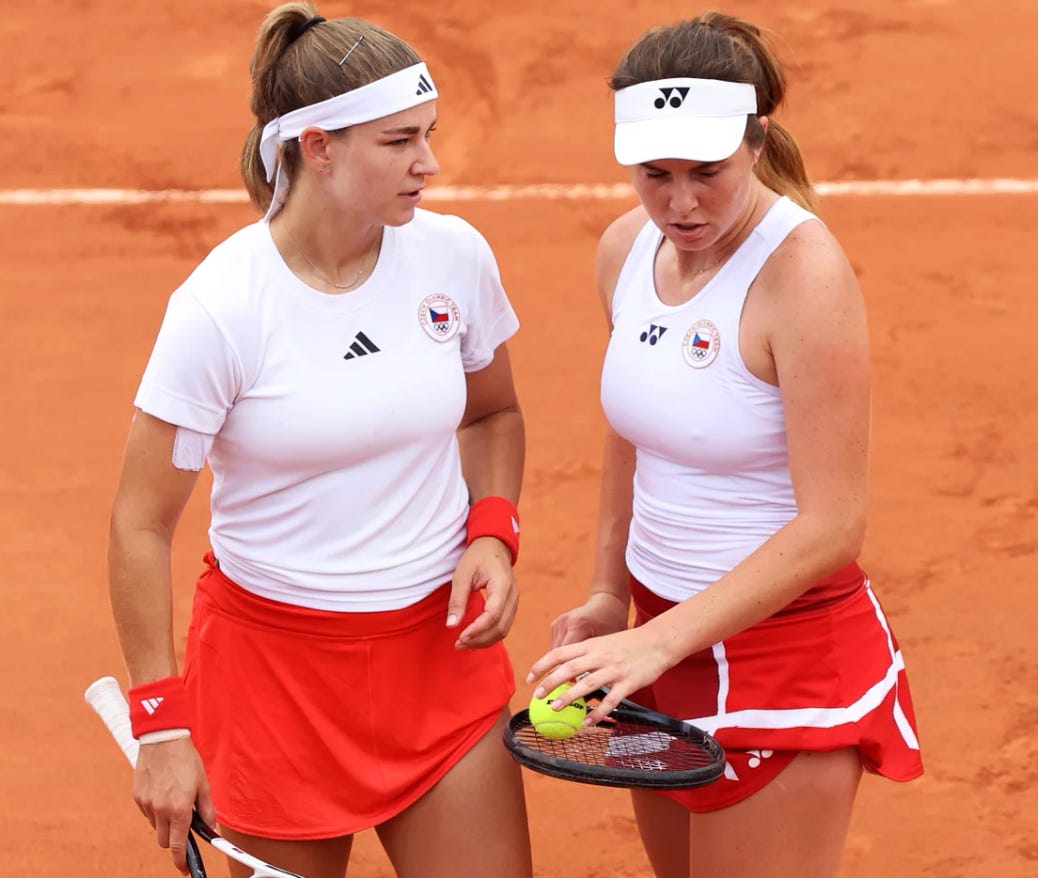
I can so often be found in Czech players’ press conferences that in Melbourne, while I was waiting for Linda Fruhvirtova after she qualified, curious about how she was getting back on track, a Czech colleague finally asked me, in a very nice way, why I was always around their players. We all laughed.
They’d see me at Barbora Krejcikova’s press conferences, Karolina Muchova’s, Jakub Mensik’s press time when he had just landed on the Tour, same for Jiri Lehecka or even the junior sisters Alena and Jana Kovackova. Doesn’t matter the round they were at. The same way you’d always see me at Petra Kvitova’s, Tomas Berdych's, or Lucie Safarova's back in the day. And so many others. As I’d often be the only non-Czech journalist in the room, I’d often get amused “what the hell is she doing here” looks. But also, when they’d cross me around on sites throughout the year, I’d often exchange a smile and a quick chat with some of them. They’re a witty, sassy pack when they decide to let it show.
So, why am I always around the Czech players? That colleague asked. Easy: I have three soft spots in tennis. A great technique, shot-making skills, and some flair. So, of course, I’m going to be around Czech tennis. I’ve now seen my fair share of generations of Czech players, and it’s always been a tennis dream to me and a mystery: How do you “produce” half a dozen top players or so per generation?! All with impeccable technique, easy power, and each with their specific tennis identity. They’re not cloning these players by following some kind of Nick Bollettieri (ultra successful) formula. No, each one of them lands with their very own tennis persona. It’s honestly baffling.
“We are very creative, I would say, so grass allows us to kind of use any side of tennis,” Noskova
Like, how do you get a spectrum going from, in recent years (because we could go all the way back to Martina Navratilova and Jana Novotna), Petra Kvitova to Marketa Vondrousova? Barbora Krejcikova to Barbora Strykova? How do you get a stream giving you Muchova and now also Nikola Bartunkova? Karolina Plisikova to Marie Bouzkova, or Sara Bejlek to Tereza Valentova? Lehecka mirroring Berdych? It is endless. And at junior level, they’re everywhere too. Every height, every power, every body type, every game style.
I’ve asked the players, the Czech colleagues, and some coaches a version of “How?” throughout the years, and my top theory is that: clubs > federations. Tradition > Formula. And: Clay.
“It's a tradition at this point, I would guess,” said Linda Noskova on Czech players’ love affair with Wimbledon. “But I would say we are all kind of brought up in the same way in Czechia, in our game styles, in our tennis, but in some ways we are very different. We are very creative, I would say, so grass allows us to kind of use any side of tennis, if it's serve and volley back in the old days, if it's slices and volleys in this new era. I would say that we have all these sides that we can use, that grass allows us, and it's showing.”
Another key to Czech success seems to be this rule: put these kids on clay first. I had so many coaches telling me that clay is where you learn the game and build the body, yet a lot of kids are still put indoors or on hardcourts first and for too long. Except for the Czechs, who spend their formative years on clay. One of the consequences of this is also that you get players who are built so complete they don’t care what their feet are on.
“Never really thought about it,” said Karolina Muchova when asked which surface she thought would be the most successful for her when she was young. “Because when I was a kid, in Czech you play on the clay most of the time. Then once you get on the tour, get that ranking, you play most of the time on hard court. I think on the grass I didn't play that many matches overall until this year, I would say. I'd say I'm pretty adaptive, that I can adapt to all the surfaces. I like them all because you can use all different types of game, weapons, spins on all the surfaces. I enjoy the changes. I actually always look forward to when we have the change and go from hard courts to clay, then grass, then back there.”
This sea of Czech players isn’t coming from a USTA to LTA and FFT or AO system. They’re being born at club level. I’ve asked them, and it’s always the same thing coming back: they started at club level, then moved to the biggest clubs of the country, most of the time in Prague, Prostejov or Ostrava, and got trained there with the same coaches who have trained decades of Czech tennis and hit there with each other a lot. Virtuous circle. Many have also picked up a racquet because there was a court nearby and parents or siblings were already playing. Very, very few of them seem to have been through a rigorous federation-like program.
“We have so many tennis schools in Czech,” Noskova explained, “even though we're such a small country. We have so many great coaches that have been working with worldwide greatest players. I really don't know. If I knew, I guess all the other countries would have been doing the same thing. I'm proud of our country for having all these great champions.”
The Czechs take full advantage of the privilege of having crazy good facilities, clearly strong local and private investment, and have cultivated a steady bunch of coaches who are not trying to reinvent the Czech wheel or copy what’s made in Florida, Beijing, Moscow, Paris, London, or Rome. There’s clear trust and pride in keeping the Czech tennis tradition up to standard. It also doesn’t look like the environment pressures these players to perform when they’re kids, and it does look like standards are set on game quality first and foremost. Two sides of that coin: much more relaxed, down-to-earth players with a nice tennis IQ and strong technical foundation, but also players who sometimes need to be convinced they can be great/win big and so have to adjust faster than others to the pressure that comes with it.
It was, for example, striking again how Noskova was baffled by her own achievement here. The tennis world had been waiting for her to get there for a little while now, but she didn’t see it coming at all.
“I couldn't really believe it, I guess,” she said. “You always want to be in those moments. You always want to win these big matches. But when it actually happens, you don't know how to react or kind of realize it. I always realize any success or any great matches or a good tournament after it's all done. Right now I feel like I am already focusing on the final.”
“It always comes out of nowhere, I guess. You can't really plan your success or good times. If I could do it, I would definitely be planning it on every Grand Slam. But after Roland-Garros I was very, let's say, mentally tired 'cause the clay season was long for me. I've had a lot of good matches, a lot of great tournaments, but the French Open was a disaster for me. I kind of had to restart, reset, focus on just enjoying the time on court. This is where it got me.”
When you haven’t been out there saying and being encouraged to say from like 5 years old that you want to be the World n°1 and win Grand Slam titles, it changes the way you see the game and also yourself. Even a player like Muchova never walked that tennis earth looking like someone convinced she’d deserve to rule them all. Getting back to a second Grand Slam final and doing it here, after the many injuries she had to go through before and after that Roland-Garros final in 2023, meant the world already to her. “It's a very special moment. It's a great achievement. This is one of the biggest tournaments that we have with all the history; so many legends were playing here, as well as just getting to play on the Centre Court, it was so nice. Yeah, just incredibly glad that it happened and that I have a chance to play another final.”
Years and years ago, I asked a top suit at the French federation a polite version of “why the hell aren’t you sending teams in Prague or Ostrava to see what’s going on there?” and also a polite version of “any good reason you’re not trying to sneak one or two of the Czech coaches?” I was met with silence and a few seconds later, the infamous, “but we have quality in France too”. I do not deny we do. I’m just wondering why we can’t also be curious about how such a small country that doesn’t invest anything comparable to the FFT, LTA, or USTA keeps outperforming all of them combined.
I mean, Tennis Canada, which has a lot of in-house talent, still came shopping in France and left with a good chunk of its coaches, starting with the one who’d rebuild Canadian tennis, Louis Borfiga. Result? Milos Raonic to Bianca Andreescu, Denis Shapovalov, Felix Auger-Aliassime, and Victoria Mboko, to name a few of them. Just saying. Nowadays, France has been looking into Italian tennis and hired someone like Ivan Ljubicic, ending that “France only” system. I’m just baffled we’re (and other tennis countries) still not camping somewhere at a tennis club in Prague, just to see. I kinda wonder if Italy didn’t do it somehow!
[Side note: It’s not a Czech coach though who has brought Muchova back to the limelight but the experienced Dutch coach Sven Groenveld (Sharapova), whom she hired last winter after another year of struggles.]
“I get this question every second day, I would say,” Muchova said when asked how tired she was of having to try to explain why Czech players were so good. “Every time I think we all answered it or tried to answer it. On one hand, it's nice to get that question because it's so good for our country and for the sport in our country. We are such a small country. This is just unbelievable and all that. But yeah, to get that question all the time, I try to answer every time differently. I don't know what to say anymore.”
Czech tennis is a wonder and a mystery we keep failing to crack. Deciding it’s all superb coincidence, just not to admit they cracked the tennis code. Another nation that is coming on the radar for its ability to get a great number of high-quality players through right now is one you wouldn’t expect, for obvious and unfortunate reasons: Ukraine, especially junior girls and WTA players. Elina Svitolina’s legacy for sure. Marta Kostyuk-inspired too, also. Still, it’s starting to be a lot of very solid players with different game styles landing on Tour from a country that doesn’t have the system or the money of the Grand Slam federations.
Coco Gauff, The Unlocked Edition
Sometimes, a loss gives more hope than a win. I feel it’s the case for Coco Gauff here, as her game is getting closer to the dream image she’s always had in her mind about it. And to where it needs to go to take over.
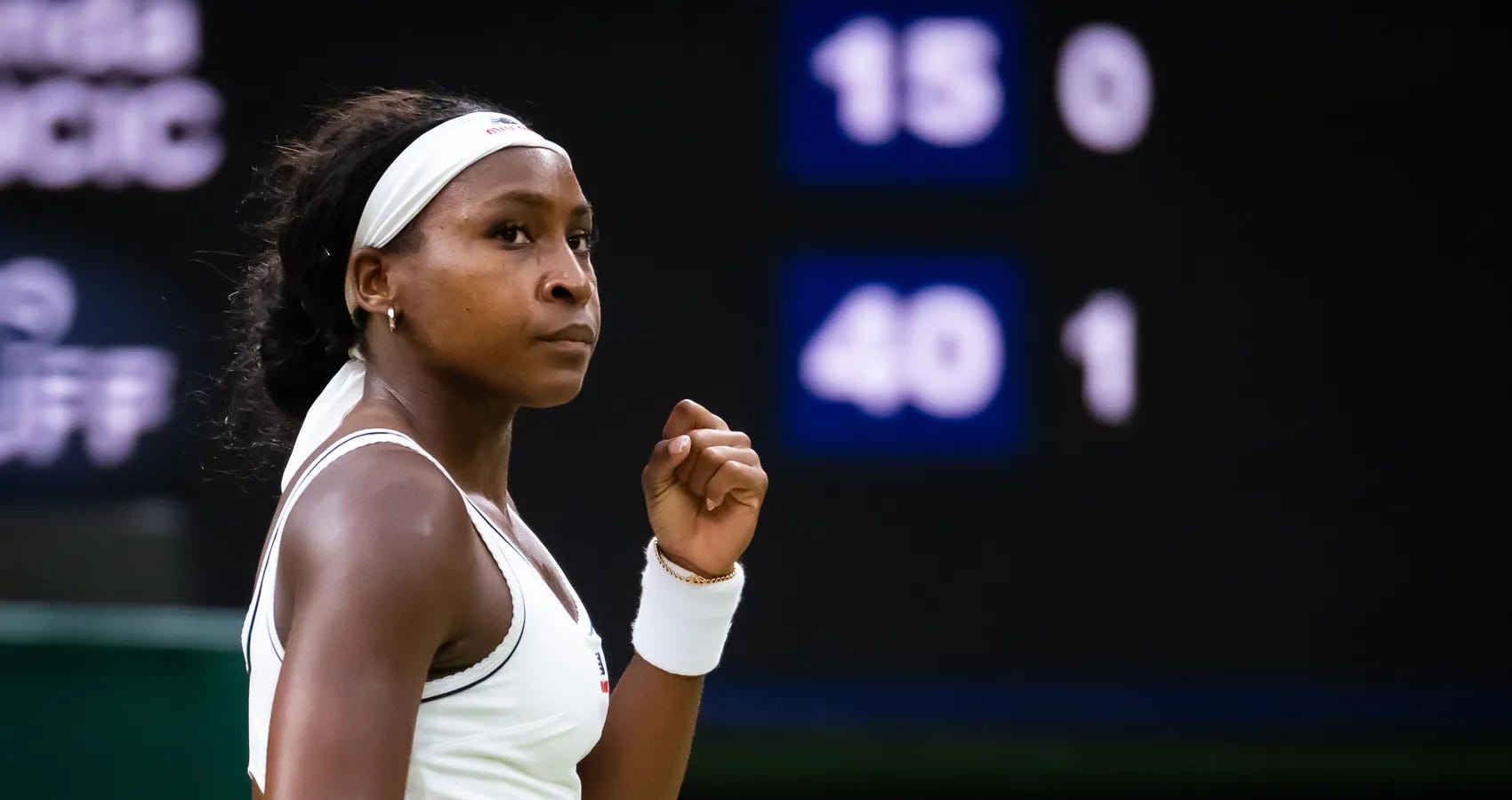
I’m way more optimistic for Coco Gauff’s game after that (crushing) loss in the semifinals of Wimbledon than I’ve been for two years after many of her wins, including her Roland-Garros title, even if it sounds weird. Coco wants to dominate the game and become a tennis icon at the level of someone like Serena Williams. She often talked about being tired of playing a game style she didn’t like and about the frustration of not being able to match the image she had of herself as a player. Many of us then said that, well, maybe the reality of her game was never going to match the vision she had for it because that vision was maybe not based on game DNA at all.
Several times this year I’ve said that Gauff and Iga Swiatek would be the storylines of the year for very different reasons than players like Aryna Sabalenka or Mirra Andreeva. Coco and Iga have been fighting their game as much as their opponents for a while now and seemed at a crossroads. Gauff was very public about her serve and forehand technical issues, hiring the expert Gavin MacMillan in what already looked like a back-on-the-wall situation despite her young age. And at Wimbledon, I feel Gauff has unlocked her game while Swiatek is still looking for that damn key.
That is what happens to her game when Gauff is no longer hampered by her technical issues.
I’m not going to ramble about THAT match point missed against Karolina Muchova during that extraordinary tiebreak. It was a penalty for a forehand, but she made a mess of it. It happens to the best out there: go replay Roger Federer’s first match point against Novak Djokovic in that 2019 final or one of the forehand mistakes from Jannik Sinner on these three match points against Carlos Alcaraz in Paris last year. It’s soul-crushing and on paper impossible to understand. The glitch in the matrix. The “what if” here is as useless as damaging if the player stays in it. Gauff was outstanding about it all when she came to the press, giving one of the most collected chats I’ve attended from a champion like this having missed such an opportunity. Give it a watch; it’s a “show them how it’s done” moment.
No, what still strikes me now is how well Gauff played in that third set. She was Muchova-ing Muchova herself: the slices, the top spin on the forehand, the net game, the aggression. It’s the best Coco Gauff I’ve seen in years. It was Coco, The Unlocked Edition. And for all the people lamenting for years now about how passive she’d play and how winning ugly had become her game plan, that set was the best answer. That is what happens to her game when Gauff is no longer hampered by her technical issues.
Gavin MacMillan, the man who whispers to flawed strokes, is close to doing it again. He fixed Sabalenka’s serve and gave her forehand a new name. And now he’s about to succeed in what even other coaches started to doubt was possible: undo everything wrong that’s been done to Gauff’s serve and forehand to free that game. It wasn’t obvious when she started Wimbledon, because her loss in Paris against Potapova was honestly shocking and the start of her grass season not much better. But when you’ve been making so many changes and making them under pressure, it’s going to take time, yet usually at some point it clicks.
And for me it clicked for Gauff during that quarterfinal against Belinda Bencic. And it has stayed. Assimilating technical changes is also a skill, so not every player gets it, and among those who do, not everyone will assimilate all this at the same speed. I was on court watching Gauff hit big first serves and super decent second serves in that third set, coming to the net with so much efficiency it reminded everybody she was a great doubles player and had great hands there, and she was able to handle Muchova’s forehand in that diagonal. She wouldn’t have been able to do any of this at the same time last year. Even a couple of weeks ago. It clicked.
Now, is it a forever click or is it a “keep it on watch” click? Impossible to say. But at least now, Gauff knows that a version of the game she has always envisioned for herself is real. I don’t believe she’ll ever be that player who hits winners all around and aces their opponents on the regular. I have a feeling she’s made peace with it for a while now, as she told us at the start of the year that the goal now was less hitting these flat shots and more building a heavier ball on that forehand, a bit like in the men’s game. That’s a good mix of her natural and impressive defensive qualities and the power she was for too long unable to unleash again. And that’s a very scary reboot of the Coco Gauff game if you’re her rivals.
“I definitely think I'm progressing in the right direction with the serve, with being aggressive,” she told me when I asked if she also felt something got unlocked here. There are definitely some points I regret maybe being passive on some of those break points. It's going to take some time putting myself in these positions to unlearn habits and build new ones. Hate me or love me, you can't deny the progress that's been made this tournament. I don't know, there's a lot of positives. It gets me excited for the future, for sure.”
So, yes, she lost that semifinal in the harshest possible way, but it’s also the first time in two years that I go, “Oh, Welcome Back, Coco Gauff.”
Great stuff, as always Carole. Totes agree on Coco unlocking her game. Huge strides, and she handled the defeat so well, reinforcing everything I believe about Coco the person as well.