
When They Keep Breaking Down
Some players keep being sidelined for weeks or months by injuries, and it's becoming the new background noise of professional tennis. Experts weigh in.

Welcome back! I’m currently in France, where we hope to finally get out of the heatwaves, the fires, and the floods… The dystopia is picking up steam. I hope you’re as safe as possible wherever you are in this crazy world.
Today’s edition is the second part (here’s the first part) of my deep dive into the tennis injuries trend we’ve been living in lately. I was especially interested in talking to experts about the “repeatedly injured” players: how they land there, how they can be helped, how to break the cycle, how to step back and wonder if the sport hasn’t pushed limits too far, etc.
This exclusive feature isn’t paywalled, so you can see the type of content that comes with a paid subscription, as I’m running that 15% discount until September 14th. And also treat yourself if you need an Airalo discount (code CAROLE9578).
Feel free to spread the word, like this post, subscribe, or leave a comment to help TSS’s discoverability. You can also buy me a cuppa!
When They Keep Breaking Down
It’s easy: either we decide that all these top athletes now spending weeks or months every year in rehab is a coïncidence or we start to seriously wonder what’s going on. Well, there’s actually another option that could be, I fear, the one tennis has opted for: You consider that this is the new normal and the price to pay for having a shot at these very lucrative careers.
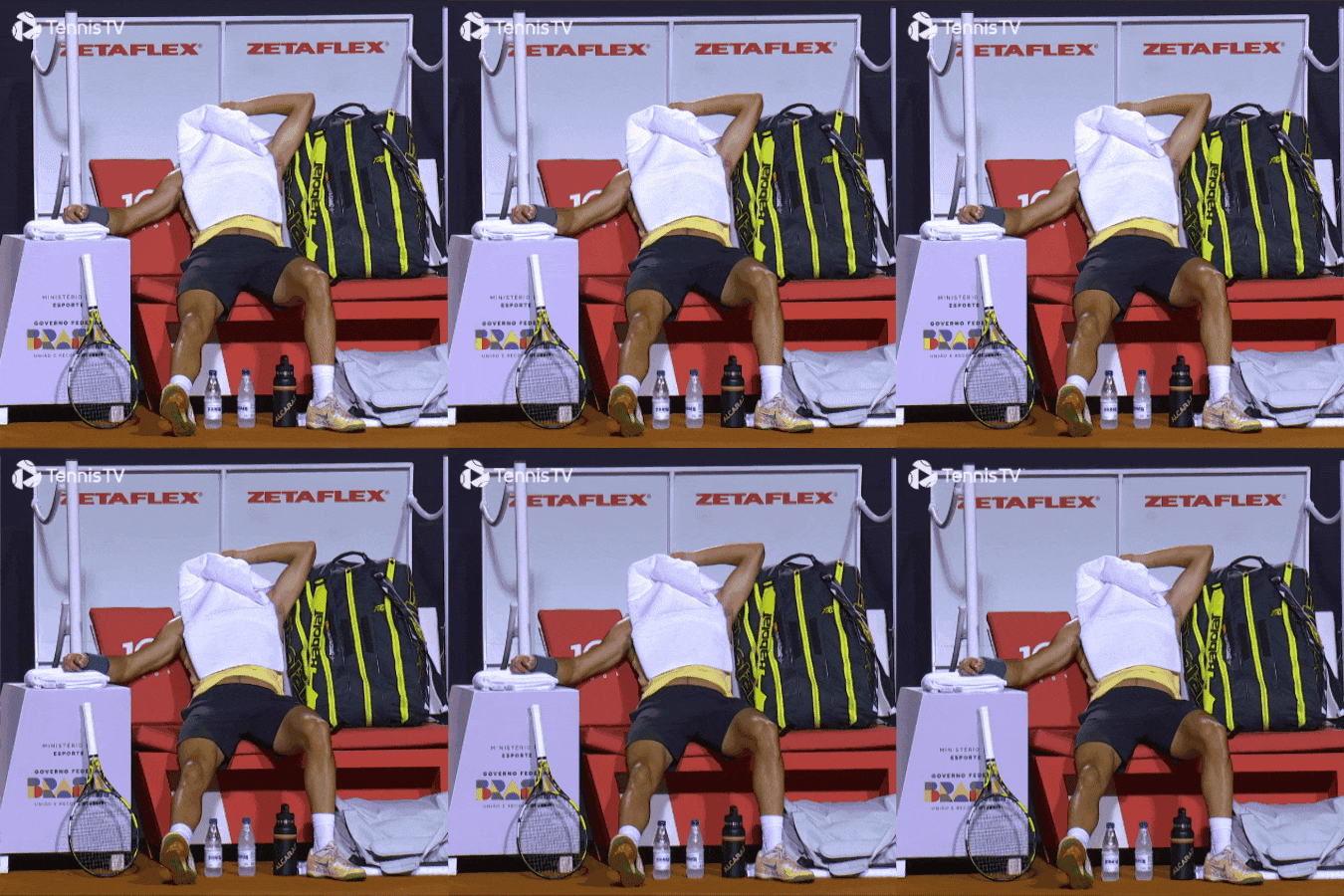
Whatever the choice ends up being, it has now become impossible for tennis to dance around the fact that it’s breaking players’ bodies down at a worrying pace these days. If you’ve been reading me for a while, it’ll be nothing new for you, as I’ve been saying over and over again that something was going on. Too many mild-to-severe injuries in players of every age and ranking. Too many joint injuries. Way too many wrists and elbows. All the stress fractures… And an astounding number of players are being exhausted in the spring already.

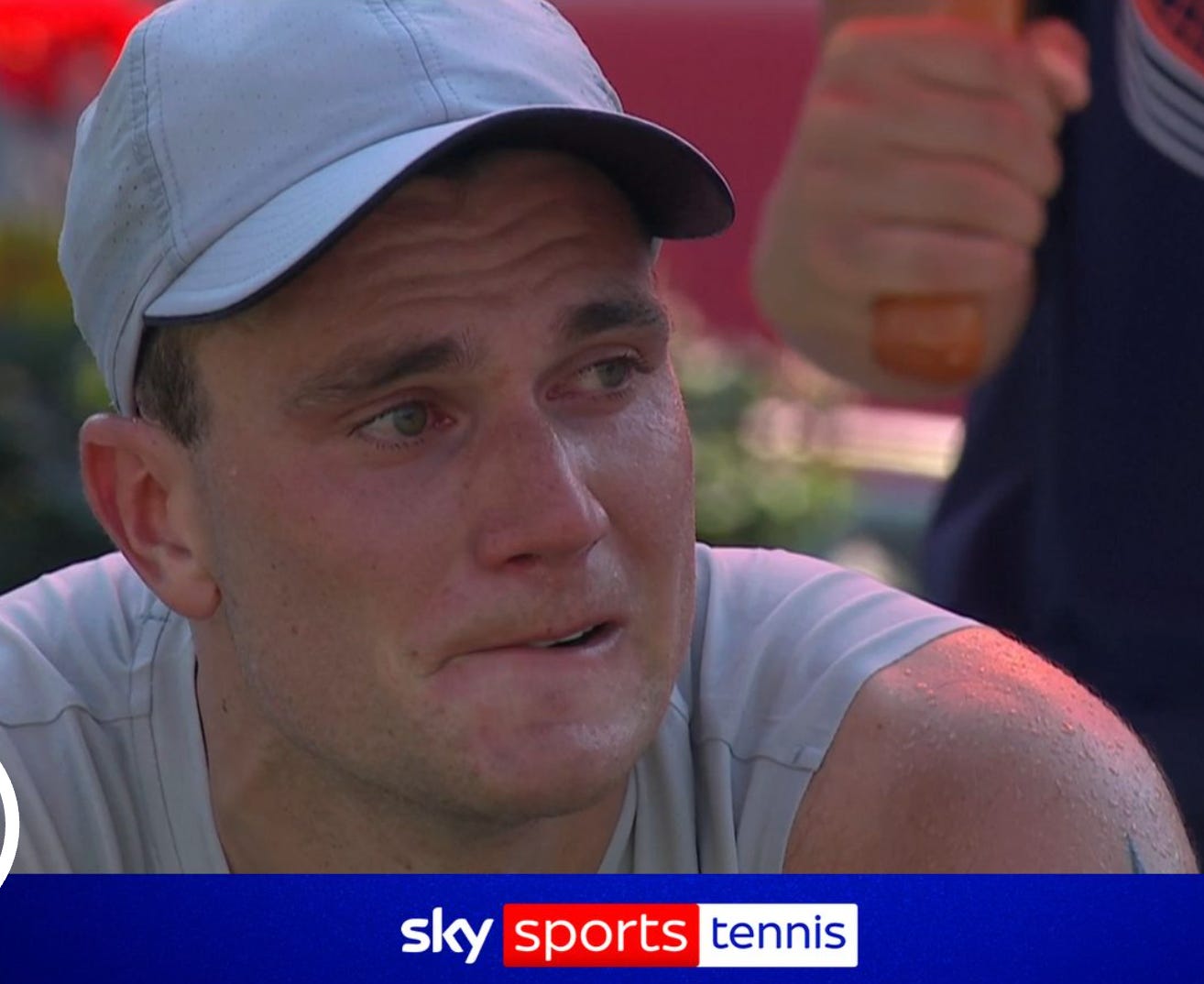
It’s now impossible to give an exhaustive list of injured or just-back-from-injury players, as there are way too many. Jack Draper is at a year of trying to fix that left arm and still struggling a whole lot mentally to cope with it all. We’re still waiting on a return date for Carlos Alcaraz. Holger Rune and Sebastian Korda are still in rehab. Arthur Fils, Karolina Muchova, or Barbora Krejcikova always seem to be touch-and-go. Lorenzo Musetti’s adductors cannot be convinced to play. Matteo Berrettini? Where do we start? Valentin Vacherot is out due to a foot injury. Hailey Baptiste and Victoria Mboko suffered knee injuries, the former much (much!) more serious than the latter. Emma Raducanu and Loïs Boisson are going from one injury to another. Bianca Andreescu? Bubble wrap that woman now. And so on, and so on.
It’s the new background noise of professional tennis. Tennis players, it’s well known, are always having a niggle here or there; it’s part of the job. But we’re way past the “just niggles” point now. And also nowadays, 99% of the field works hard on the fitness side, so it’s overall not a work ethic issue at all. I’ve written multiple times about how the two-week 1000s had pushed an already shaky system over the edge. I’m not getting on this again, but you can read my latest posts on it here:



What’s been interesting to me this time is the very specific case of these players who just can’t catch a break. Someone like Lorenzo Musetti, for example, cannot find a way around these adductor issues that, for now, are seriously damaging his career, coming up at the worst times (Melbourne was unreal, and Rome looked like cruelty was the point as the Italian has now missed Roland-Garros and Wimbledon). More and more top players seem to take the wrong page out of Juan Martin Del Potro’s book, and I had to ask experts about 1) How do you deal with players who keep getting injured (same area or multiple areas), and 2) what’s going on here? So I picked the brains of biomechanics and fitness training experts to try to get the bigger picture.
How to help the repeatedly injured?
I often wonder a lot about that. The main question is, of course, how do these players cope with all that? But the second one for me is, how do their teams or the professionals hired on the way deal with these situations? How do they even find a way to help at this point? How does one work with these players in an efficient way? By efficient, I mean: a way that’s going to 1) heal them 2) get them back to competition at the desired level to win 3) make sure they stay healthy. These top players are now followed by a team of fitness and health experts, so money and access to expertise aren’t the issue here. When your player keeps breaking down or when a player who keeps breaking down comes to you for help, how do you even deal with the situation? Where do you start, as they’ve for sure already piled on files and files of medical and training trials?
A fitness trainer would be in the first line of response here for a player. That’s why I asked the experienced Laurent Laffite, who has worked with both top French ATP and WTA players for the French Tennis Federation (where he’s also the trainer of the Davis Cup team), and international players like Victoria Azarenka and Garbine Muguruza. Fitness trainers build these bodies to perform and endure, right? I was very curious to have Laurent’s opinion on the “forever injured” of tennis these days. He started by making a distinction between players who will be regularly injured in the same part of the body and players who regularly break down in multiple areas.
“We have players who have a real sensitivity somewhere,” Laffite said. “And there, it’s a very difficult situation that I have, for now, had the chance not to be confronted with. Yet, I remember someone like Alizé Cornet who had recurring adductor issues, and I think she did everything that could be done. It’s really the most delicate situation, because at some point, you’re going to generate a fear, I would say, conscious or unconscious. It’s difficult, because you’re really going to lose confidence in this area of your body. So you’re going to avoid engaging yourself. You risk avoiding situations, actually, but as the saying goes, fear does not avoid danger. So it’s really a situation that is difficult to take into account.”
“Who knows me since I’ve been a kid knows that I’ve been getting injured since I was 12, basically. It’s kind of like part of who I am,” Matteo Berrettini
But when the recurring injuries start to be from everywhere? “Then it’s the other case where you have players who are not robust enough… The game is at the center of all this. For me, the game is anyway at the center of all this: It’s the evolution of the game. Today, for example, we see that the wrists are extremely solicited areas, extremely sensitive, at risk. The wrist, for me, it’s really a disaster. Given the amount of wrist injuries and the duration of inactivity it imposes, I can only use the word disaster.”
Some players know it’s all coming from their game styles, and so the bargain becomes constant. I asked Matteo Berrettini at Roland-Garros about how he was coping with all the times his career has been derailed by injuries. I was surprised when I saw him smile… And then I got it. I mean, it’s either you develop this thickest “zen-like” skin about it, or you don’t pick up the racquet ever again. “Of course, when injuries are coming, you’re always negative, and you don’t want to stop, and you are thinking about I could have done this, I could have done that,” the Italian told me. “But at the same time, I’m looking at myself in the mirror right now, and I’m so proud of my career and what I’ve achieved. Who knows me since I’ve been a kid knows that I’ve been getting injured since I was 12, basically. It’s kind of like part of who I am. If I have a big serve, big forehand, I also have this issue. I also have a resilient mind, and I always work hard to come back. I just like to compete. I like to put myself in situations where most people would struggle a little bit. I’m just a little bit psycho, I think (he laughed).
Yet for Laurent Laffite, the constraints the sport is now putting on these players’ bodies might have reached an entirely other level. “With a little hindsight, I think tennis generates adaptations which are not good adaptations for the integrity of the body. And when we start to observe these adaptations, I think that’s where we start to enter a risky situation.
Let me take an example: If you let your player have a shoulder going forward ... Well, if your shoulder goes forward, that comes to show something is pushing it this way, and that’s tennis. And if you train on these situations, we know that this situation will cause a problem. So, you can consider it as an accident, but if you have seen it, and if you are sensitized to the problems of postures, you can anticipate it, or at least decrease it by saying, well, listen, it’s better if we solve this problem now, because if you’re going to play with this posture, this should not end well.
Also, it’s a chain reaction. It’s dominoes. For example, you have a pain in the elbow. Yes, but if you didn’t pay attention to what’s going on above and below, maybe the elbow is just compensating for what’s going on above and below. That’s why it’s important to have a team that is able to observe these things.”
Fitness trainers also depend a lot on what the players actually share with them. Tennis these days is all about injury prevention, but the foundation of all this is also communication. John Williams, whom the readers of TSS know very well by now as we already chatted about coaching and tennis adversity to change and how he helped Taylor Townsend to break her ceiling in singles, pointed to this during our discussion. These players have to be taught to communicate about their body. “Tennis is rife with obsessive behavior. And I’m not even talking about the clinical obsessive. I’m just saying the amount of repetition, the amount of routine, the ritual, all of those things, it’s extremely important if you want to be successful in the sport. I’m not saying that that is the problem. What I’m saying is it becomes very difficult for a young player to differentiate between when they are mentioning an area that may become a problem for them because they feel something abnormal and when they’re actually complaining about it. If they don’t understand the difference between the two as they’re developing, as they’re growing up, and if that environment is not conducive to them sharing information that is important, then they will not share that information. And if they don’t share that information, then you are only reacting. You cannot be proactive because you never really know what’s going on.”
The fascinating part of trying to help the “repeatedly injured” is that the more you talk with the people tasked to do it, the more it feels like detective work. I was talking with Caroline Martin, one of the biggest tennis names in biomechanics who has worked and is working with many top players and aspiring top players, when she mentioned being a tennis version of Sherlock Holmes. Regularly, a player comes through her doors because an injury keeps coming back and the time has come to wonder if the technique was causing it and/or if another technique would suit better. And so begins the detective work.
“The idea is to try to glean as much information as possible from the player and his staff,” Martin told me. “We then have all the elements of context and try to understand in what context the injury occurred. Is it something recurrent? When it’s something recurrent, it can’t be bad luck. You have to see the level of gravity, the recurrence, the elements of context. You have to debrief with the medical staff too. It’s a bit like Sherlock Holmes, to get the most out of it.” Martin also insists that, to help solve these recurring injuries, it will lead to examining every area of the player’s life. “What is complicated is that injuries are often multifactorial. And so it’s hard to isolate a single cause because it can come from the technique, it can come from the constitution of the athlete on the anatomical level. It can come from their training load or their tournament load or a lack of recovery, a period of fatigue. It can be related to travel, jet lag, the surface, etc. There are so many parameters that can come into play that it’s complicated.”
“When it’s something recurrent, it can’t be bad luck. You have to see the level of gravity, the recurrence, the elements of context. You have to debrief with the medical staff too. It’s a bit like Sherlock Holmes, to get the most out of it,” Caroline Martin
Biomechanics is a growing force in tennis training, especially with stars like Aryna Sabalenka and Coco Gauff now being very public about it, and it’s even bigger in injury prevention or treatment. “We now know, because there are scientific studies that have put it in evidence, that some technical elements can lead to shoulder overload, back overload, etc. We then try to check with the player whether they are there or not. We put red flags. Yes, you have back pain, but did you see your toss? Did you see the excessive extension? Well, there’s a causal link here. The idea is to go on objective data and to say that your technique is potentially traumatic. It will be combined with when you are going to be tired, when you are going to be a little less well. When the physical preparation has not been done, it will be accentuated. So now, we try to change this technical element in your game. Do the constraints decrease or not? When they do, we can think that this technical option is one of the best.”
Unfortunately, it’s often the last step a player will take to investigate recurrent injuries. “It often happens on the abs, on the back, the shoulders. They come in because in the span of two years, there have been four or five lesions to the abs, minimal alerts included. (…) It’s true that there are some athletes stuck in problems, always in the same area. And often they don’t dare to touch their technique because it’s complicated. And so they’re going to do everything there is to do around it. That is to say, the physical preparation, the hours with the physio, maybe also diet changes. But the technique is often the thing we want to change last, especially with players who are already among the best in the world. They sometimes have services that are very performant in terms of pure performance, like speed of the ball, etc. And maybe changing the technique also means taking the risk that for it to be less demanding on the body, it will work less well in terms of performance. So that’s not easy.”
Not easy overall to touch an area players have been honing and trusting for years. And an area so tightly tied with their emotions too. Changing a serve or a forehand can send many to a bonus therapy session. “It’s sure that touching the technique, it’s still something complicated,” confirmed Caroline Martin. “Because these are things that are anchored, that they have repeated hundreds of thousands of times, even millions of times. And so, at some point, you’re going to have to be able to reset and detach yourself from these sensations. And when there is stress, when there is fatigue, we go back to what we know how to do best. It’s not easy because it affects the psychological aspect as well.”
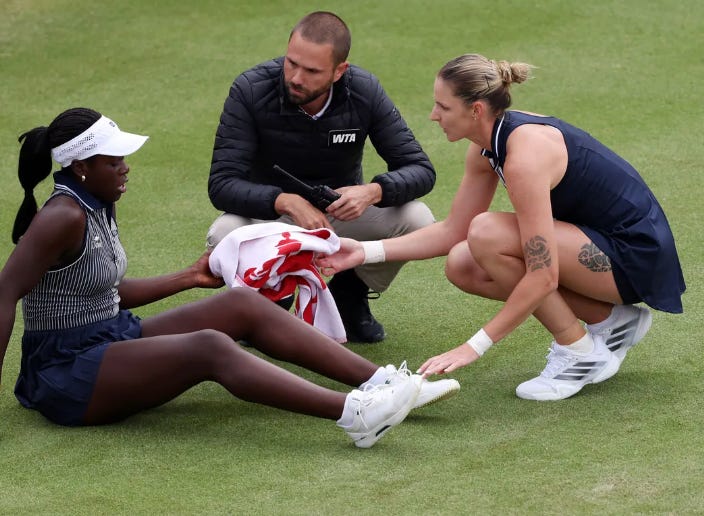
You also have players who seem to be followed by some kind of curse of various levels of intensity. Bianca Andreescu coming back from a knee injury to pick up a back injury or to come back from that injury and then badly sprain an ankle. Sensation of the past two years, Victoria Mboko has already spent more time in recovery and rehab than a lot of players her age due to knee issues when she was a junior, was still having a knee issue at the start of the year, picked up a pec injury from Strasbourg to Roland-Garros, and ended up damaging a knee on the grass after a bad fall. I can still hear her telling me with a smile in Paris that dealing with that pec injury would be no problem because she has been going through so many injuries already that she knows what’s up. She’s 19. Do we consider teens breaking down now also the norm?
“They are not fragile; they are exposed to enormous constraints,” Laurent Laffite
As Laurent Laffite already said, for him everything starts with the game. And it also goes with the way players are adapting or trying to adapt to it. Here would also lie the core of the issue. “What I often repeat is that sitting in your chair you will not hurt yourself; same in the gym. But on a tennis court, it is so violent and so repetitive that at one point you risk an injury, so there are two ways to see things: either we consider that it is only tennis that generates these problems there, or it is the wrong adaptation to tennis. Today there are still a lot of players who are really super fit and work every day, even if some do less than others. So for me, we do not pay enough attention to the evolution of the body that is trained every day and how that translates into the sport. They are not fragile; they are exposed to enormous constraints. (…) We could also talk about the material, but I’m not even sure where we should start there because today’s players are getting stronger physically, so they will hit harder and harder, but has the material evolved as quickly as the players’ physicality? Every two or three years, the level is getting higher.”
When to know when the system is the issue?
Sometimes you look at a player who keeps getting injured, and you just wonder why they don’t burn the house down. It’s logical to think that if you keep meeting the same issues, it’s either ingrained in you or it’s ingrained in your system, no? These are people whose perfectionism and “thriving to be the best version of myself” mentality brought them to this level of success, and yet here they will somehow accept staying in the same frame that’s been producing the same results over and over again. It’s always mesmerizing to infuriating to me.
John Williams, who has seen multiple sides of the issue working on performance, coaching, and rehabilitation of athletes in a wide variety of sports, isn’t surprised at all. It’s the pattern. It’s part of the problem, and it keeps having dire consequences. “The challenge that I have found is that when I get players that have had a history of injury, and this doesn’t matter the sport, the first thing that they often say is, we’ve tried everything. Okay. So if you are of that mindset that you genuinely think you’ve tried everything there is to try, then why keep trying? What you should be saying is, everything we’ve tried so far has been unsuccessful, but I know I’m not the first person in the world who’s ever had to do this, so there must be a solution. We just haven’t found it. So that’s the first thing: Changing the mindset of the player, because ultimately the player is the one who has to deal with the consequences. They have to deal with the fact that they’re not playing or playing in pain. All of those things are major factors, and they weigh very heavily on the psyche.”
The second thing is, what exactly have you been doing, and who’s been doing it? Because there are the conventional ways of doing things, and then there are the exceptional ways of doing things. And most athletes and players are very stuck in the conventional way of doing things. When you think inside the box, then the only thing that you’re going to get is box cut. So if you are looking inside the box, and people are doing things the way that they’ve always done them, then you’re probably going to get similar or exactly the same results that people have already always had. And if those results are unremarkable or undesirable, then you can’t be surprised, right? So you say you’ve tried everything, but what you really mean is you tried the same thing. Now I’m going to expand out a little bit and say that the industry as a whole does a terrible job at embracing new ideas and new technology because they want to protect what it is that they think they have.”
“So you say you’ve tried everything, but what you really mean is you tried the same thing,” John Williams
It’s the same for how long some of them now wait before pushing the door of biomechanics experts. Doesn’t matter the repeated pain, doesn’t matter the poor performance of a shot, doesn’t matter it’s been years of coaching changes, rehab, losses, and repeat. “When a player comes, unfortunately for the moment, they come because they are injured,” confirmed Caroline Martin. But why would they wait for so long before asking for help despite having all the means to do so? Isn’t she surprised? “Yes and no. Yes, it’s true, sometimes you see a player finally coming, and you know it’s because they got injured, or I watch one play and I say to myself, this one for sure is going to get hurt. And it happens, and then I wonder what they were waiting for. But at the same time, they have so many things to consider: the points, the money, the schedule. And then again, the player has to be convinced, the staff has to be convinced. So sometimes it takes time before you reach that final reasoning. Then you have to actually change the technique, and sometimes it takes several months.”
What’s the most common situation she sees? “For me, the classic one is the player who is always injured in the same place, and hasn’t been able to get rid of it for several months. Let’s take the example of a shoulder injury: The problem doesn’t necessarily come from the shoulder. What is interesting is that often, there is probably another part of the body that is not doing its job well so that the player comes to overload his shoulder and compensates for the deficit. Often, with a shoulder problem, we will look at what happens at the level of the legs. This push from the legs might not be efficient enough, or it’s a move from the hip that comes too early and puts the shoulder in a delicate position. We look at the shoulder, but we also look at everything that happens upstream because there are compensation mechanisms that are put in place.” And so if they don’t come and ask, they might keep rehabbing a shoulder whereas tweaking the way they push on their legs could be the solution.
Yet, Martin sees signs for hope. Mentalities are changing. “With younger players, there is this notion in the staff now that careers are going to be long and there’s the need to protect the long-term. I worked with Moïse Kouamé, for example, in December as he had suffered a back injury and his staff wanted to prevent it from happening again, and they also wanted a complete check-up as at 16 he wasn’t done with his growth, hasn’t reached his maximum potential either obviously, so how do we help him have the longest career possible? I wasn’t necessarily hearing things like that before.”
“I worked with a top player not long ago, but I’m not allowed to give names, and the approach was also very interesting. The coach told me he serves very well; he’s very powerful; that’s great. But he’s young, and we’d like to get him to serve maybe a little less well, but that he’s more efficient. That is to say that he spends less energy. Even if the speed drops by 5 km per hour, we don’t care. He’s already so powerful. And we would like him to have a very clean technique. That, for me, is a bit new, as usually it’s about gaining speed and wanting more, more, more. Sure, but the body has to be able to handle these constraints. I have the impression that in the staff of younger players, there is now this concern about longevity and efficiency. The more isn’t always better.”
It’s good to hear that some are indeed fighting back against this kind of “yeah, it’s just tennis… That’s gonna hurt…” mentality that’s been creeping in lately in front of that epidemic. “That’s really difficult,” commented John Williams. “Because, indeed, people just say, oh, that’s tennis. They just accept that that is a part of it, instead of denying that this is going to be our reality. So everybody else may have to deal with this, but this is not my reality for you. This is not what I want for you. And breaking that pattern is extremely difficult, especially if you’ve been in that pattern for a long time.”
And so we go back to the moment it’s time to look at your whole system and wonder if it’s not time for the rest button or at least a redesign. It demands a moment of clarity from the entire team, explains fitness trainer Laurent Laffite. “When your player is not robust enough, I don’t think you should fall into an excess. He hurt his shoulder, so we’re going to do shoulder routines. Then he hurt his knee, so we’re going to do knee routines, in addition to shoulder routines. The risk is to move away from a certain logic, which would mean that the system put in place, and be careful, I don’t criticize anyone when I say that, but the system that is put in place is not enough to strengthen the body. If you don’t change the system, but you only reinforce the areas that have broken, well, there is little chance that it won’t break elsewhere. Because your weak point, in the end, evolves, it changes area. In these moments, we must rethink the training system, but training in the broad sense of the term. It can be physical, here, it can be physical and tennis, but it can be the physio work, it can be the nutrition. Doesn’t it generate risky situations? It’s pretty interesting, at some point, to consider taking a step back to wonder if the system we propose might come to hurt the player, adding pressure on their weak links.”
“If you don’t change the system, but you only reinforce the areas that have broken, well, there is little chance that it won’t break elsewhere,” Laffite
It’s no question that changing the whole system is a massive decision to make, especially for players who are already at the top of the game. The stakes are at the highest. The moment you say, " Hey, let’s change that serve motion or " Hey, let’s tweak your training,” you’re playing with a career. There’s no way around it. If you’re already a Top 10 player, it’s a heavy choice. “You have to be more greedy than you are afraid,” answered John Williams when I asked him about the weight of that decision. “So, if you are more greedy than you are afraid, then you’re hungry, you want the results, right? You want the results and good performances that you know you can produce. And if that means you have to throw everything away and start from scratch, then that’s what you do because you want the results more than you are afraid that doing that is going to set you back or whatever. No margin for mediocrity. If you aspire to be at the top, then everything that supports you has to be above that. So it can lift you.”
Is there a “the body just can’t do it” acknowledgement moment to have?
I felt like playing the devil’s advocate here, because at some point it has to be asked. Nobody dares say it out loud, because that sounds awfully ominous. I get it. But sometimes it crosses my mind that this amazing player might just not have the body that goes with his tennis skills. Sometimes I wonder if these players who keep breaking down aren’t also meeting their bodies’ limits. We see the top players being out there swinging deep in their thirties or those who can play every other week with the usual tennis niggles but not the career-hampering injuries, and we take it for the norm. But maybe 1) It’s not, 2) It’s going to become rarer and rarer, 3) there’s a norm on the other side that, in these days where the demands on the body have reached fever peak, pushes one’s body to say “yeah, you know what, it ain’t for me.”
Maybe, for some, there would be nothing to do as it’s just that their body isn’t made to cope with all that and never will. Laurent Laffite doesn’t say it’s something to put aside, but he cannot accept the fatality here. “I would tell you that I heard this being said, but I can’t resign myself to that. Every time a player asks you to work with them, it is an amazing challenge, and you can’t tell them listen if you get injured, I’m sorry, but it’s not my fault; it’s just your body that cannot take it. Today we have super measuring tools, super monitoring tools, and thanks to that we must be able to limit the injuries as much as possible. Small injuries are a bit inevitable in high-level sports, but injuries that end careers or make them stop for months… These we must find a way to reduce as much as possible. If in our job we start saying that this or that player is followed by some kind of curse, then there’s nothing more to do for us except keep going in the same path. No, you must keep looking for solutions. Every brain in the team gets into it depending on their expertise, and in the end you have to solve this. Discipline is the key word at this level.”
As the players and their teams keep searching for answers and for strategies to avoid the flood of mild to severe injuries (like, do we have the record for stress fractures by now?), I’d feel much better if it looked like the sport as a whole was also looking into it. Sometimes they swear they do, as nothing is more important than their players’ health, but it all feels like a performative act as serious injuries keep piling, not sparing the top of the game (aka the ones the business is tied to), but nothing is actually changing. Well, they’ve started trying to do something for these balls; it’s one thing, let’s praise what can be. Repeatedly injured players aren’t bad luck, nor a curse or a lack of abilities, but the growing red flag the sport is still refusing to tackle head-on.

Really, Really, Really interesting topic!